







Introduction
Employees face different types of hazards during their daily activities, including physical injuries, chemical exposure, electrical accidents, machinery-related risks and health problems. Without proper safety planning, these hazards can lead to serious injuries, financial losses, legal problems and reduced productivity.
A Workplace Risk Assessment is an essential process that helps organizations identify potential hazards, evaluate the likelihood of accidents and introduce suitable control measures. It allows employers to understand what could go wrong and take preventive action before an incident occurs.
Whether a business operates in construction, manufacturing, healthcare, transportation or an office environment, a proper Workplace Risk Assessment helps create a safer working environment.
This guide explains the meaning, importance and five essential steps of Workplace Risk Assessment, along with practical examples, employer responsibilities and effective prevention strategies.
What Is Workplace Risk Assessment?
Workplace Risk Assessment is a systematic process used to identify workplace hazards, evaluate possible risks and determine appropriate measures to prevent accidents and occupational illnesses.
A hazard is anything that has the potential to cause harm, while risk refers to the likelihood that someone could be harmed and how serious the consequences might be.
For example, an uncovered electrical cable is a workplace hazard. If an employee accidentally touches it, the potential risk could include an electric shock, burns or even death.
The main purpose of Workplace Risk Assessment is to identify such dangers before they cause harm.
Employers should regularly review workplace conditions, employee activities, equipment, materials and safety procedures to ensure that hazards are properly controlled.
Why Is Workplace Risk Assessment Important?
A proper Workplace Risk Assessment provides several benefits for employers, employees and organizations.
1. Prevents Workplace Accidents
Identifying hazards early helps employers take preventive action. Safety measures such as machine guards, warning signs, protective equipment and safe operating procedures can significantly reduce workplace accidents.
2. Protects Employee Health
Employees may experience long-term health problems due to noise, dust, chemicals, poor ventilation and repetitive movements. Workplace Risk Assessment helps identify these exposures and introduce appropriate health protection measures.
3. Improves Workplace Productivity
A safe working environment allows employees to perform their duties confidently. Fewer accidents mean less downtime, fewer disruptions and improved operational efficiency.
4. Supports Legal Compliance
Employers must follow applicable occupational health and safety laws and regulations. Risk assessments help organizations identify safety gaps and demonstrate that reasonable preventive measures are being taken.
5. Reduces Financial Losses
Workplace accidents can result in medical expenses, compensation claims, damaged equipment and production delays. Preventing hazards can reduce these unnecessary costs.
6. Builds a Positive Safety Culture
When employers involve employees in safety activities, workers become more aware of potential dangers and are more likely to report unsafe conditions.
5 Essential Steps of Workplace Risk Assessment
Employers can follow a structured approach to identify hazards and control workplace risks. The following five steps provide a practical framework for effective safety management.
Step 1: Identify Workplace Hazards
The first step is to identify anything that could potentially cause injury, illness or damage. Employers should inspect the workplace carefully and observe how employees perform their daily tasks. Common workplace hazards include:
- Physical hazards: Noise, vibration, extreme temperatures and poor lighting.
- Chemical hazards: Cleaning products, toxic gases, solvents and industrial chemicals.
- Biological hazards: Bacteria, viruses, fungi and contaminated materials.
- Ergonomic hazards: Poor posture, repetitive movements and heavy lifting.
- Electrical hazards: Damaged wires, overloaded sockets and exposed electrical components.
- Mechanical hazards: Unguarded machinery, moving equipment and sharp tools.
- Psychological hazards: Workplace stress, bullying, excessive workloads and fatigue.
Employers can identify these hazards through workplace inspections, employee interviews, incident reports, safety audits and equipment assessments.
Step 2: Identify Who Might Be Harmed and How
After identifying hazards, employers should determine who could be affected and how serious the consequences might be. Different employees may face different levels of exposure depending on their job responsibilities. For example:
- Cleaning staff may face chemical exposure.
- Construction workers may be exposed to falling objects and working-at-height hazards.
- Office employees may experience back pain due to poor workstation design.
- Maintenance workers may face electrical and confined-space hazards.
- Visitors and contractors may be exposed to unfamiliar workplace conditions.
Employers should also consider workers who may require additional protection, including new employees, temporary workers and individuals with specific accessibility needs.
Understanding who might be harmed makes Workplace Risk Assessment more effective and helps organizations select suitable safety measures.
Step 3: Evaluate Risks and Decide on Control Measures
The third step involves evaluating how likely a hazard is to cause harm and how serious the consequences could be. Employers can use a simple risk matrix to prioritize workplace hazards.
| Risk level | Meaning | Recommended action |
| Low | Minor injury is unlikely | Monitor and maintain controls |
| Medium | Injury is possible | Introduce additional precautions |
| High | Serious injury is possible | Take urgent corrective action |
| Critical | Potential for severe or fatal harm | Stop unsafe work until controlled |
Example:
A factory employee operates a machine without proper guarding. The possibility of hand injuries may be high, and the consequences could be severe. Suitable control measures may include installing machine guards, emergency stop buttons, providing operator training and introducing regular maintenance inspections. Employers should always prioritize eliminating hazards where reasonably practicable rather than relying only on personal protective equipment.
Step 4: Record Findings and Implement Safety Measures
Once hazards have been identified and evaluated, employers should document their findings and implement appropriate control measures. A written Workplace Risk Assessment record should include:
- Identified workplace hazards.
- Employees or individuals who may be affected.
- Potential consequences of each hazard.
- Existing safety precautions.
- Risk levels and priorities.
- Additional control measures required.
- Responsible persons for implementing actions.
- Completion dates and review schedules.
Documentation helps employers monitor safety improvements and ensure that identified problems are addressed.
For example, if an inspection identifies slippery floors in a production area, management can introduce anti-slip flooring, warning signs, regular cleaning schedules and employee awareness training.
Step 5: Monitor and Review the Risk Assessment
Workplace conditions can change over time. New machinery, additional employees, different materials and changes in work procedures may introduce new hazards. Therefore, employers should regularly review their Workplace Risk Assessment to ensure that existing control measures remain effective. A review should be conducted when:
- A workplace accident or near miss occurs.
- New equipment or machinery is introduced.
- Work activities or production processes change.
- New chemicals or hazardous materials are used.
- Employees report unsafe working conditions.
- Existing control measures are no longer effective.
- New legal or industry requirements become applicable.
Regular monitoring ensures that Workplace Risk Assessment remains an ongoing safety process rather than a one-time activity.
Common Workplace Risk Assessment Methods
Organizations can use different methods depending on their industry, workplace size and operational activities.
1. Workplace Inspection
A workplace inspection involves physically examining work areas, equipment, tools and employee activities to identify unsafe conditions. It is particularly useful in construction sites, factories, warehouses and industrial environments.
2. Job Safety Analysis (JSA)
Job Safety Analysis examines individual tasks by breaking them into smaller steps. Each step is reviewed to identify hazards and determine suitable preventive measures. It is especially useful for maintenance, equipment operation and other high-risk activities.
3. Risk Matrix
It provides a simple way to prioritize hazards and decide which risks require immediate attention.
4. Employee Consultation
Employees understand their daily tasks and often recognize hazards that management may overlook. Consulting workers, supervisors and safety representatives can improve hazard identification and strengthen workplace safety.
5. Safety Audits
Safety audits evaluate whether workplace procedures, safety policies and control measures are being followed effectively. They help identify weaknesses in an organization’s overall safety management system.
Examples of Workplace Risk Assessment in Different Industries
Workplace hazards vary depending on the nature of business operations. Employers should use industry-specific approaches when evaluating risks.
- Construction Industry
Construction workers may face falls from heights, falling objects, electrical hazards, excavation accidents and heavy machinery risks. Preventive measures include:
- Providing appropriate fall protection.
- Inspecting scaffolding and ladders.
- Using suitable personal protective equipment.
- Installing warning signs and barriers.
- Conducting regular site safety inspections.
- Manufacturing Industry
Manufacturing environments may involve moving machinery, hazardous chemicals, excessive noise and repetitive tasks. Employers should install machine guards, provide hearing protection, maintain equipment and train employees in safe operating procedures.
- Office Environment
Office employees may experience ergonomic problems, eye strain, stress, electrical hazards and slips or trips. Suitable controls include ergonomic furniture, proper lighting, cable management, regular breaks and good housekeeping.
- Healthcare Industry
Healthcare professionals may face infectious diseases, needle-stick injuries, chemical exposure and physical strain. Organizations should provide infection-control procedures, appropriate PPE, safe sharps disposal systems and staff training.
Hierarchy of Controls in Workplace Risk Assessment
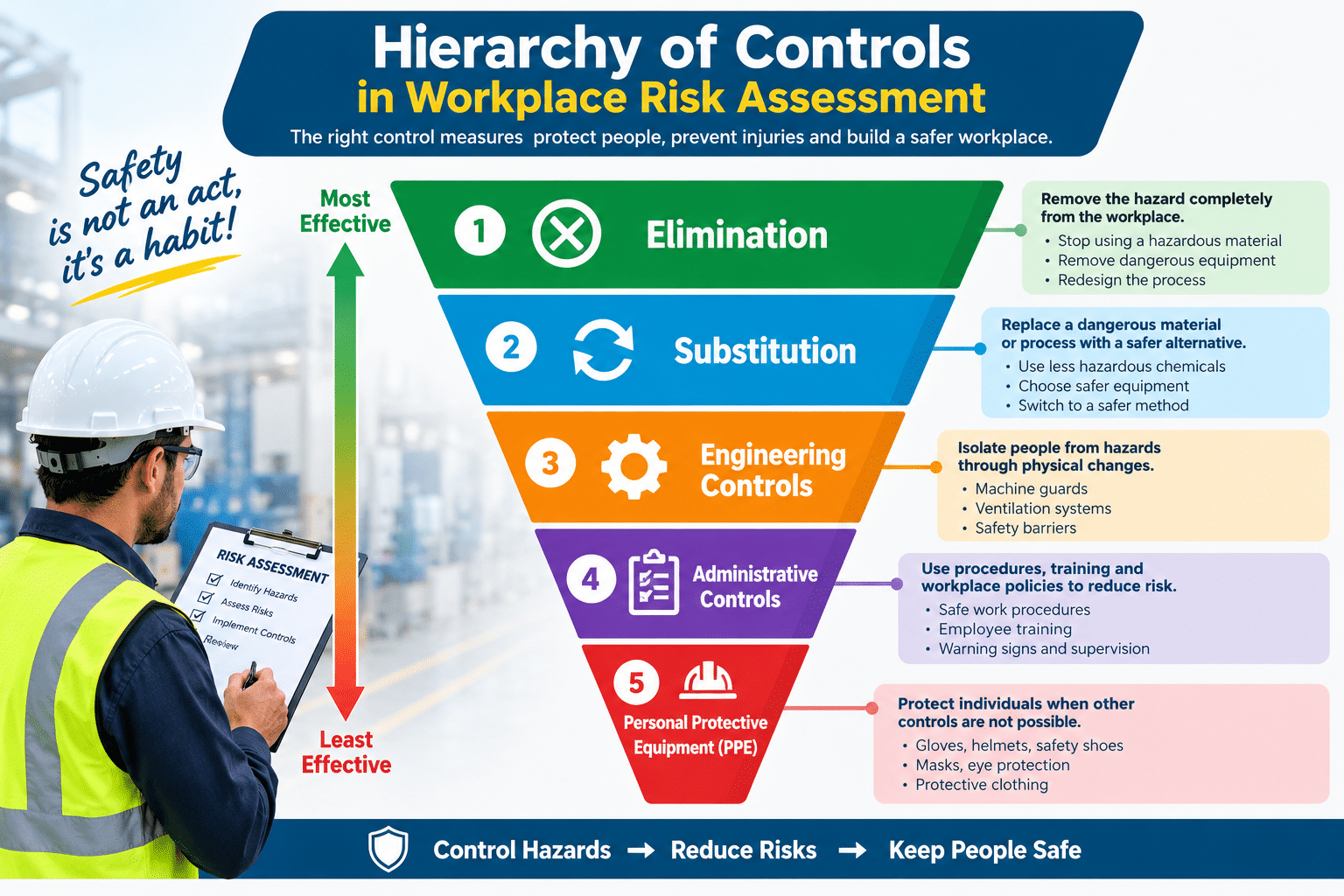
One of the most effective ways to manage workplace hazards is to follow the Hierarchy of Controls. This approach ranks safety measures according to their effectiveness.
The five levels include:
Elimination: Completely remove the hazard from the workplace.
Substitution: Replace a dangerous material or process with a safer alternative.
Engineering Controls: Isolate people from hazards through machine guards, ventilation or safety barriers.
Administrative Controls: Introduce safe working procedures, training, warning signs and work schedules.
Personal Protective Equipment (PPE): Provide gloves, helmets, safety shoes, masks and protective clothing.
Elimination is generally the most effective option, while PPE is considered the least effective level when used alone. Employers should combine control measures when necessary to provide stronger protection.
Employer Responsibilities for Workplace Risk Assessment
Employers play a major role in maintaining a safe and healthy working environment. Their responsibilities generally include:
- Identifying and evaluating workplace hazards.
- Providing safe equipment and working conditions.
- Developing clear occupational health and safety policies.
- Training employees in hazard awareness and prevention.
- Supplying appropriate personal protective equipment.
- Maintaining accurate safety records.
- Investigating workplace accidents and near misses.
- Reviewing risk assessments when conditions change.
- Consulting employees about workplace safety concerns.
Employers should also understand the applicable occupational health and safety legislation in their country and industry. In Pakistan, relevant federal and provincial labour laws and workplace safety requirements should be considered.
Common Mistakes to Avoid During Workplace Risk Assessment
Even organizations with established safety policies can make mistakes that reduce the effectiveness of their risk management activities. Common mistakes include:
Ignoring minor hazards: Small hazards can lead to serious accidents if left unaddressed.
Not involving employees: Workers may have valuable information about everyday workplace risks.
Using outdated assessments: Changes in equipment and work processes require reassessment.
Relying only on PPE: Protective equipment cannot replace effective hazard elimination and engineering controls.
Poor documentation: Missing records make it difficult to track safety improvements.
Lack of employee training: Workers need practical knowledge to recognize and report hazards.
Failing to review control measures: Safety precautions must be monitored to confirm that they continue to work.
Avoiding these mistakes can help organizations improve their safety performance and protect employees from preventable harm.
How Technology Is Improving Workplace Risk Assessment
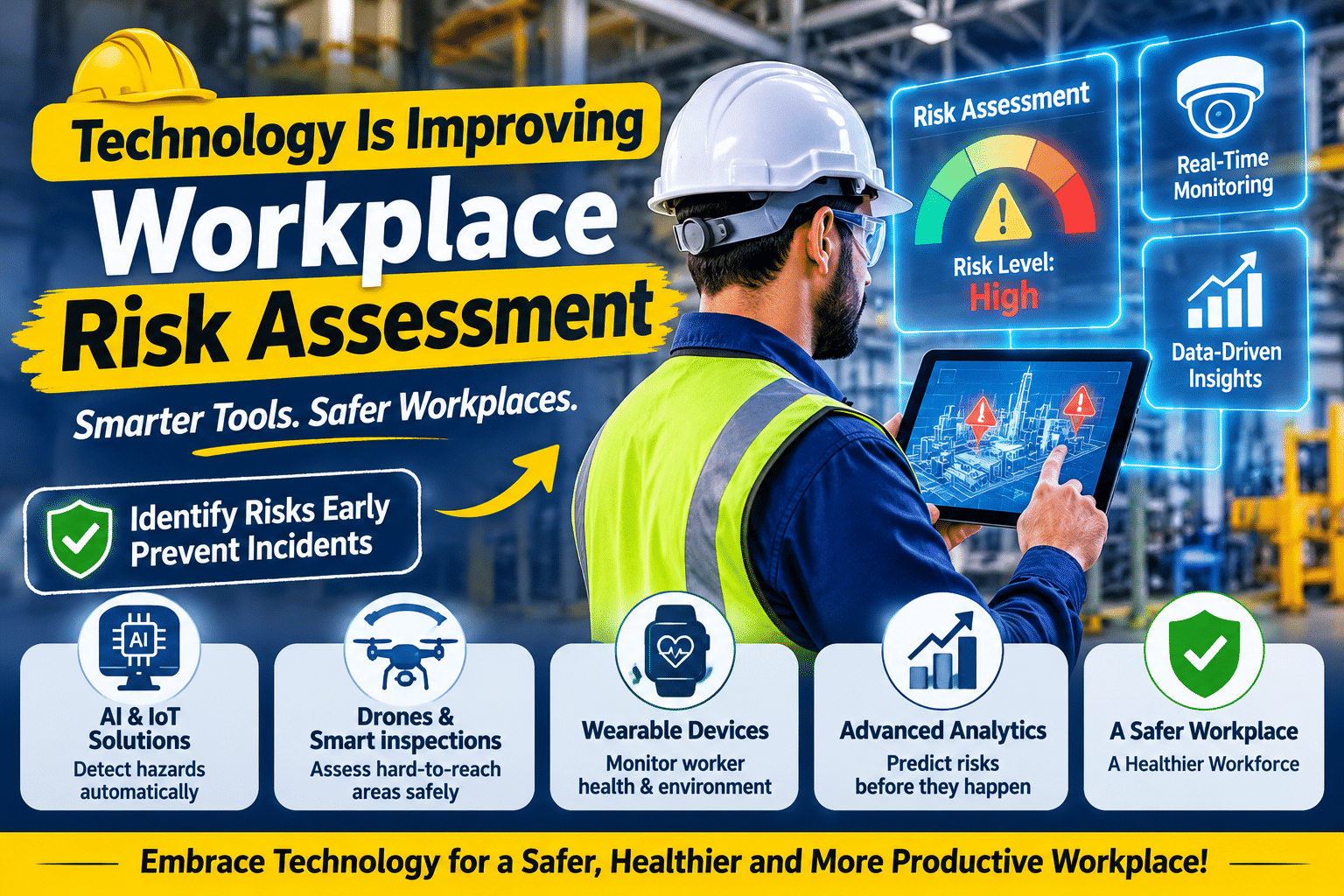
Modern technology is changing how organizations identify and manage workplace hazards. Digital safety management systems allow employers to record inspections, track corrective actions and monitor safety performance.
Artificial intelligence can help analyze incident data and identify patterns that may indicate emerging risks. Wearable safety devices can monitor environmental conditions and alert workers to certain hazards. Other useful technologies include:
- Mobile applications for workplace safety inspections.
- Smart sensors for detecting gas leaks and temperature changes.
- Digital reporting systems for accidents and near misses.
- Drones for inspecting difficult-to-access locations.
- Predictive analytics for identifying potential safety problems.
Although technology can improve risk management, employers should continue to involve trained safety professionals and employees in decision-making.