



Introduction
Food safety is becoming increasingly technology-driven. Every day, food moves through complex supply chains involving farms, processing facilities, warehouses, transportation networks, restaurants, and retail stores. Detecting contamination or quality problems at any stage can be challenging.
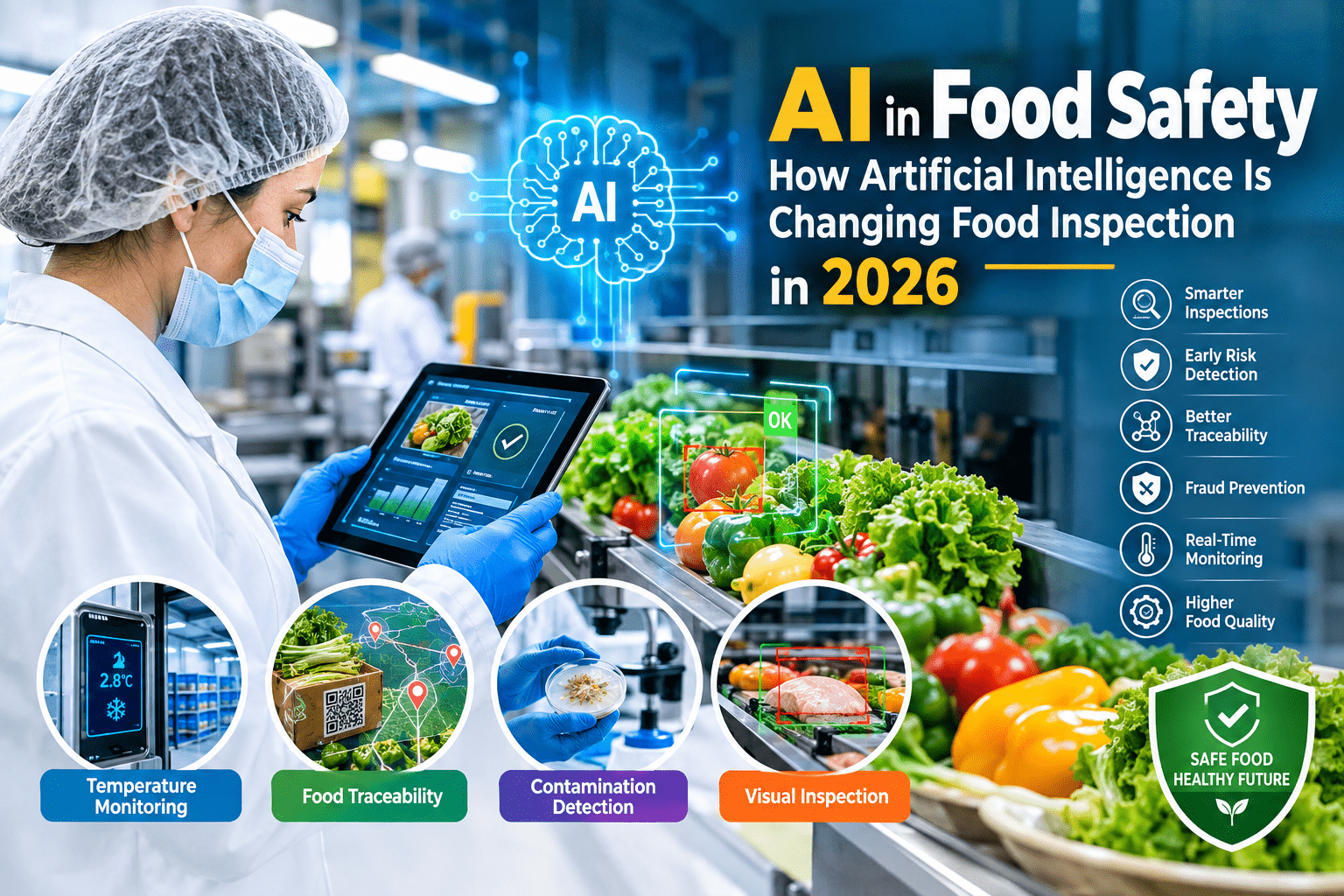
In 2026, AI in food safety is emerging as an important technology for improving how food businesses identify hazards, monitor processes, analyze data, and respond to potential food-safety problems.
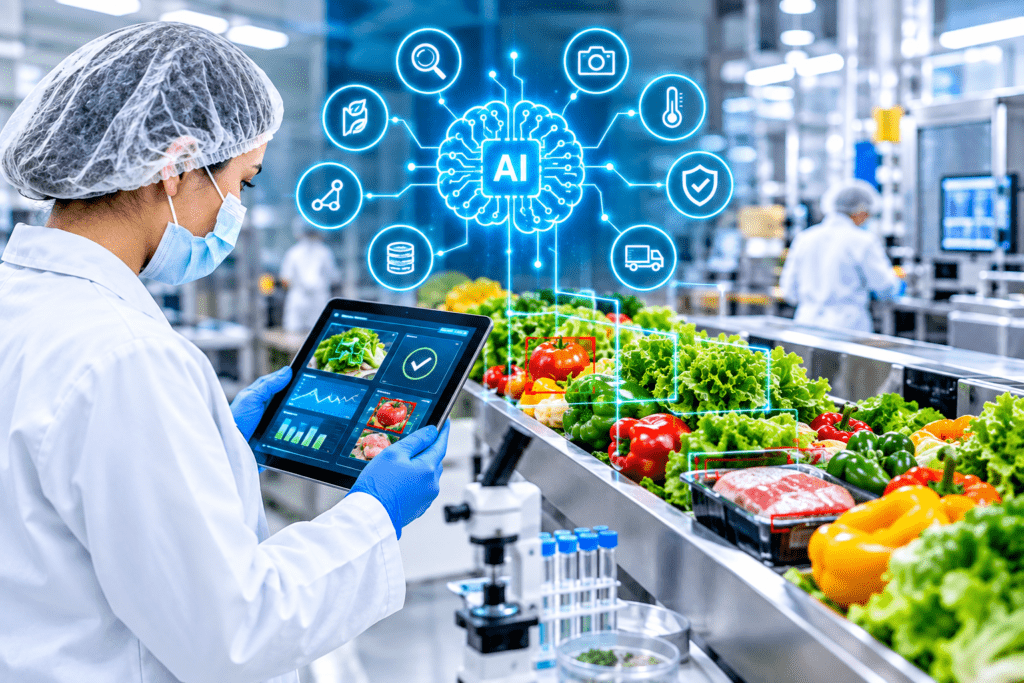
When combined with cameras, sensors, laboratory data, digital records, and other technologies, AI can help food businesses identify unusual patterns and potential risks earlier.
However, AI is not a replacement for food-safety professionals, laboratory testing, regulatory inspections, or established preventive systems such as HACCP. Instead, it can provide additional information that helps trained professionals make better-informed decisions.
What Is AI in Food Safety?
AI in food safety refers to the use of artificial intelligence and related technologies to identify, predict, monitor, and manage food-safety risks. AI systems can analyze information from different sources, including:
- Production data
- Temperature sensors
- Images and video
- Laboratory results
- Supply-chain records
- Environmental monitoring systems
- Consumer complaints
- Inspection records
- Historical food-safety data
Machine-learning systems can identify patterns in this information and potentially highlight situations that require further investigation.
For example, an AI-powered monitoring system could analyze temperature data from refrigerated storage and identify unusual temperature patterns that may indicate a problem with cold-chain management.
How AI Is Changing Food Inspection in 2026
Traditional food inspections often depend heavily on visual observations, documentation, sampling, laboratory testing, and professional judgment. These methods remain essential, but AI can add another layer of monitoring and analysis.
1. Faster Detection of Potential Contamination
One important application of AI in food safety is identifying patterns associated with contamination. AI can analyze information from previous incidents, environmental monitoring, production records, and laboratory results. If unusual patterns appear, the system can alert food-safety teams for additional investigation.
AI itself does not automatically prove that food is contaminated. Instead, it can help identify where further testing or inspection may be appropriate.
2. AI-Powered Visual Inspection
Computer vision is another developing application. Cameras can capture images of food products or production areas, while AI systems analyze those images for specific characteristics. Depending on the system and application, computer vision may help identify:
- Damaged products
- Foreign objects
- Packaging defects
- Incorrect product appearance
- Production-line abnormalities
- Hygiene-related issues
3. Better Temperature Monitoring
Temperature control is critical for many foods, particularly perishable products.
- Refrigerators
- Freezers
- Cold rooms
- Delivery vehicles
- Food warehouses
- Processing equipment
For example, rather than waiting for an employee to notice that a refrigerator has repeatedly exceeded its target temperature, an intelligent monitoring system could flag the pattern for investigation. This is one of the practical ways AI in food safety can support preventive food control.
AI and Food Traceability
Modern food supply chains can involve numerous suppliers and distribution points. When a safety problem occurs, identifying the source quickly can be difficult. A traceability system may contain information about:
- Suppliers
- Production batches
- Processing dates
- Transportation
- Storage temperatures
- Distribution locations
- Product destinations
Better traceability can also support faster investigations and more targeted product recalls.
AI for Food Fraud Detection
Food fraud is another area where AI technologies are attracting attention. Food fraud can involve intentional substitution, adulteration, misrepresentation, or incorrect labeling of food products. For example, AI systems may assist with analyzing:
- Product specifications
- Supplier information
- Pricing patterns
- Laboratory results
- Geographic information
- Historical fraud incidents
Advanced analytical technologies can also be combined with AI to help authenticate certain foods. Importantly, an AI-generated alert should normally be treated as a signal for investigation rather than automatic proof of fraud.
AI and Predictive Food Safety
One of the most interesting applications of AI in food safety is predictive analysis. Traditional food safety often focuses on detecting problems after they occur or controlling known hazards through preventive procedures.
Predictive AI attempts to identify patterns that could indicate an increased risk before an incident happens. For example, a system could analyze historical information about:
- Weather conditions
- Production environments
- Temperature records
- Microbiological results
- Cleaning schedules
- Equipment performance
- Previous incidents
The system could then identify combinations of factors that deserve additional attention. This approach may help food businesses move toward more data-driven preventive food-safety management.
AI and Food–borne Illness Investigations
Food-borne illness outbreaks can be complicated because investigators need to examine many sources of information. AI can assist with organizing and analyzing large datasets during investigations. Potential information sources include:
- Inspection reports
- Laboratory results
- Food histories
- Supply-chain records
- Geographic information
- Production records
- Consumer reports
AI can help researchers identify connections that might be difficult to detect manually. However, public-health professionals and investigators still need to verify findings using established epidemiological, laboratory, and regulatory methods.
Benefits of AI in Food Safety
The growing use of AI in food safety offers several potential benefits.
1. Faster Data Analysis
AI can process large quantities of information quickly, helping organizations identify patterns that might otherwise take considerable time to review.
2. Continuous Monitoring
Unlike occasional inspections, automated systems can potentially monitor certain processes continuously.
3. Early Warning
AI-based systems may identify unusual conditions and provide alerts before they develop into larger problems.
4. Improved Traceability
AI can help analyze complex supply-chain records and support investigations and recalls.
5. Reduced Repetitive Work
Automating certain inspection and monitoring tasks may allow food-safety professionals to spend more time on higher-level investigations and preventive activities.
6. Better Decision Support
AI can provide food-safety teams with additional data and analytical insights that support professional decision-making.
Challenges
Despite its potential, AI in food safety also has limitations.
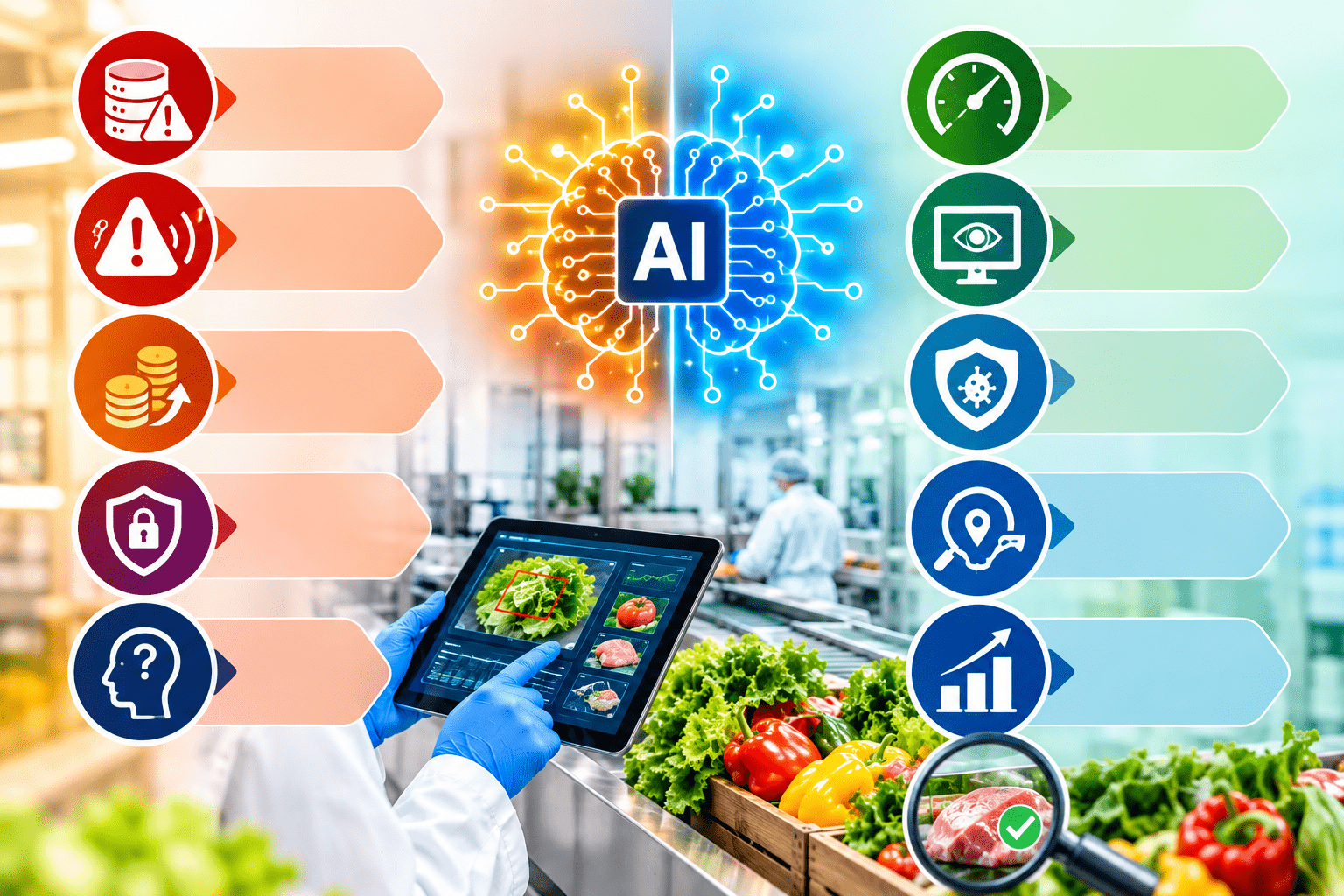
Ø Data Quality
Ø False Alerts
An AI system may identify something unusual that turns out not to be a genuine food-safety problem. Human investigation remains important.
Ø Implementation Costs
Sensors, software, cameras, data systems, training, and maintenance can require significant investment.
Ø Privacy and Cybersecurity
Food businesses increasingly rely on digital systems. Protecting operational, supplier, customer, and production data is therefore important.
Ø Lack of Human Judgment
AI can analyze patterns, but food-safety decisions often require professional knowledge, context, experience, and regulatory judgment.
For these reasons, AI should generally be viewed as a decision-support technology rather than a complete replacement for food-safety professionals.
AI vs Traditional Food Inspection
AI does not necessarily mean that traditional food inspection will disappear. Instead, the two approaches can complement each other.
Traditional inspection provides:
- Human observation
- Professional judgment
- Physical verification
- Interviews
- Sampling
- Laboratory testing
- Regulatory enforcement
AI-supported inspection can provide:
- Rapid data analysis
- Continuous monitoring
- Pattern recognition
- Automated alerts
- Image analysis
- Predictive analytics
Combining these capabilities can create a more comprehensive food-safety management approach.
How Food Businesses Can Prepare for AI in Food Safety
Food businesses do not necessarily need to adopt complicated AI systems immediately. A practical starting point is to improve the quality of existing food-safety data. Businesses can:
- Digitize important inspection records.
- Monitor refrigeration temperatures.
- Maintain accurate supplier information.
- Strengthen traceability systems.
- Establish clear data-quality procedures.
- Train employees in digital food-safety tools.
- Continue using HACCP and other established food-safety systems.
- Test AI systems before relying on their recommendations.
- Protect food-safety data from unauthorized access.
- Keep qualified professionals involved in decision-making.
Starting with a clearly defined food-safety problem can be more useful than adopting AI simply because it is a new technology.
The Future of AI in Food Safety
The role of AI in food safety is likely to continue expanding as sensors, digital traceability systems, laboratory technologies, computer vision, and data analytics become more sophisticated. Future food-safety systems may increasingly combine multiple data sources to provide a more complete picture of food-chain risks.
The biggest opportunity may not be replacing inspectors or food-safety specialists. Instead, it may be giving them better information at the right time. Successful implementation will require reliable data, appropriate validation, cybersecurity, employee training, regulatory oversight, and responsible human supervision.