







Introduction
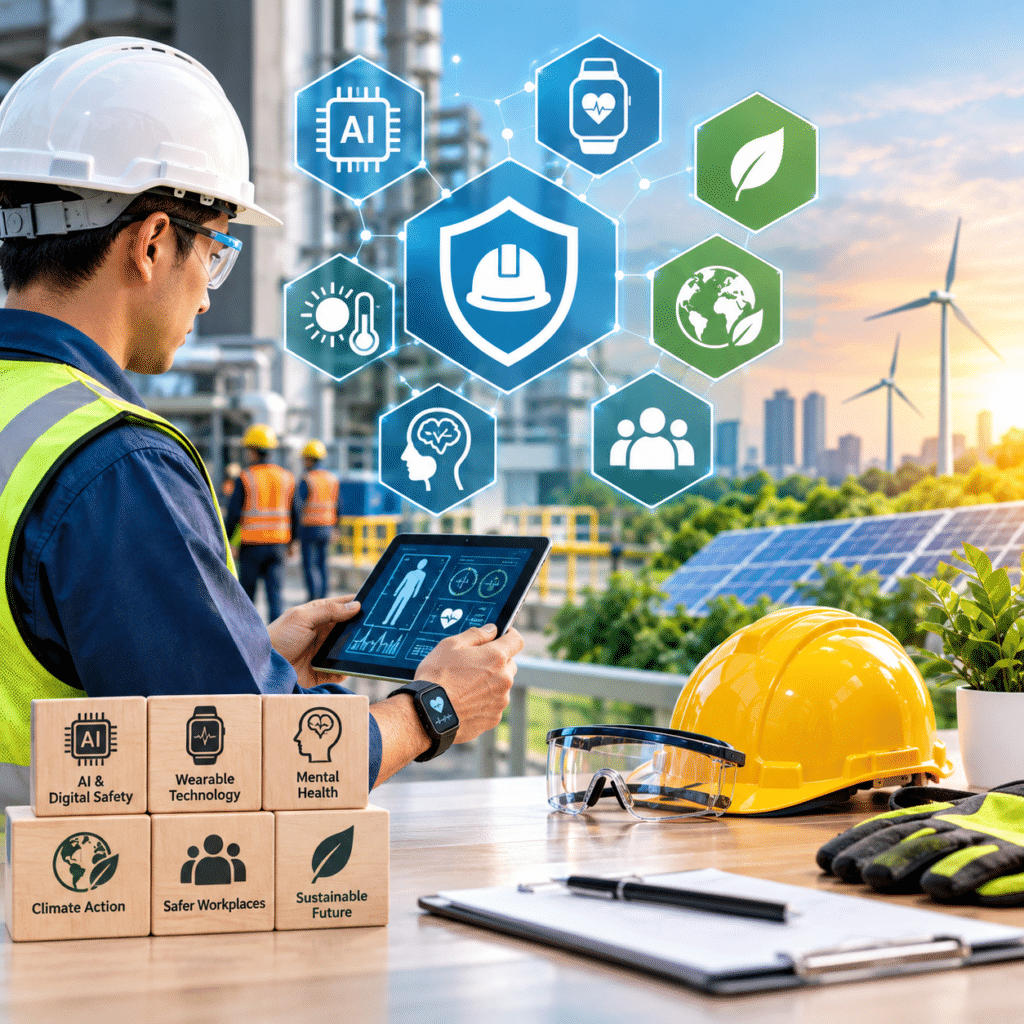
Health and Safety Technology is changing the way organizations identify hazards, protect employees, and prevent workplace accidents. Instead of relying only on traditional inspections and responding after an incident, businesses can increasingly use artificial intelligence (AI), smart sensors, wearable devices, robotics, and data analytic to identify risks earlier.
The International Labour Organization (ILO) reports that AI, automation, robotics, smart monitoring systems, and digital tools can help reduce hazardous exposure, prevent injuries, and improve working conditions. At the same time, these technologies can introduce new risks that require proper policies, training, and worker participation.
How AI Is Changing Workplace Prevention
AI can process large amounts of information much faster than traditional manual methods. In workplace safety, this can help organizations recognize patterns in incidents, near misses, equipment problems, and environmental conditions.
For example, predictive systems can analyze historical safety information and identify situations that may indicate an increased risk of serious incidents. In September 2026, OSHA highlighted the potential of predictive analytics and leading indicators such as high-severity exposures and near misses to identify developing risks before someone gets injured.
This represents a major shift from reactive safety management toward prevention based on data and early warning signals.
Smart Monitoring and Sensors
Environmental sensors may track factors such as air quality, noise, dust, gases, temperature, and other hazards.
Smart systems can provide alerts when conditions become unsafe, allowing supervisors and workers to respond more quickly. EU-OSHA notes that smart digital systems can support real-time risk monitoring, decision-making, emergency responses, and a more proactive safety culture.
These systems can be particularly valuable in factories, construction sites, warehouses, laboratories, mines, and other environments where conditions can change rapidly.
Wearable Technology for Workers
Smart watches, sensors, connected protective equipment, and other wearable can potentially monitor factors such as movement, posture, location, fatigue, heart rate, or exposure to environmental hazards.
However, wearable technology should be introduced carefully. Organizations need clear rules about what information is collected, why it is collected, who can access it, and how workers’ privacy is protected.
AI and Robotics Can Reduce Dangerous Work
Robotics and automation can remove workers from some hazardous environments. Machines can perform repetitive, physically demanding, or dangerous tasks, reducing direct exposure to certain risks.
The ILO reports that robots and automation can take on hazardous work while helping reduce repetitive tasks. However, workers who operate, maintain, or work alongside robots can face new risks, including machine failures, unpredictable behavior, human-machine interaction hazards, and cybersecurity threats.
Therefore, automation should be accompanied by proper risk assessments, worker training, maintenance procedures, and emergency controls.
AI Can Support Safety Training
Technology is also changing workplace safety training. AI-powered platforms can help personalize learning, identify knowledge gaps, and provide employees with safety information relevant to their tasks.
Virtual reality (VR) and extended reality (XR) can provide realistic simulations for hazardous situations without exposing workers to real danger. The ILO identifies virtual and extended reality among the digital technologies that can transform occupational safety and health.
This can be especially useful for emergency response, equipment operation, fire safety, confined spaces, and other high-risk activities.
Climate and Environmental Risk Monitoring
Health and safety technology is also becoming useful for managing environmental hazards such as extreme heat. OSHA’s current heat-prevention guidance emphasizes identifying heat hazards and using engineering and administrative controls, alongside sufficient rest, shade, and fluids.
As climate-related workplace risks receive greater attention, digital monitoring can become an additional tool for prevention.
Challenges of Using AI for Safety
AI is not a complete replacement for safety professionals or human judgment. Poor-quality data, inaccurate algorithms, system failures, cybersecurity problems, and excessive dependence on automated recommendations can create additional risks.
There are also psychosocial concerns. The ILO’s 2026 research identifies issues including workplace surveillance, reduced autonomy, data-driven management, and work intensification as potential risks associated with AI systems.
For this reason, organizations should use technology transparently and ensure workers are involved in its implementation.
The Future of Health and Safety Technology
The future will likely involve greater integration between AI, sensors, wearables, robotics, digital reporting systems, and predictive analytics. Instead of isolated safety tools, organizations may increasingly use connected systems that combine information from equipment, employees, workplaces, and previous incidents.
The goal should be simple: identify hazards earlier, make better decisions, and prevent injuries before they occur.
Conclusion
AI, smart monitoring, wearable, robotics, predictive analytic, and immersive training can improve hazard detection and support safer workplaces.
Organizations need trained employees, strong safety procedures, privacy safeguards, reliable data, human oversight, and meaningful worker participation. The best results will come when technology strengthens not replaces the human side of workplace health and safety.