







Introduction
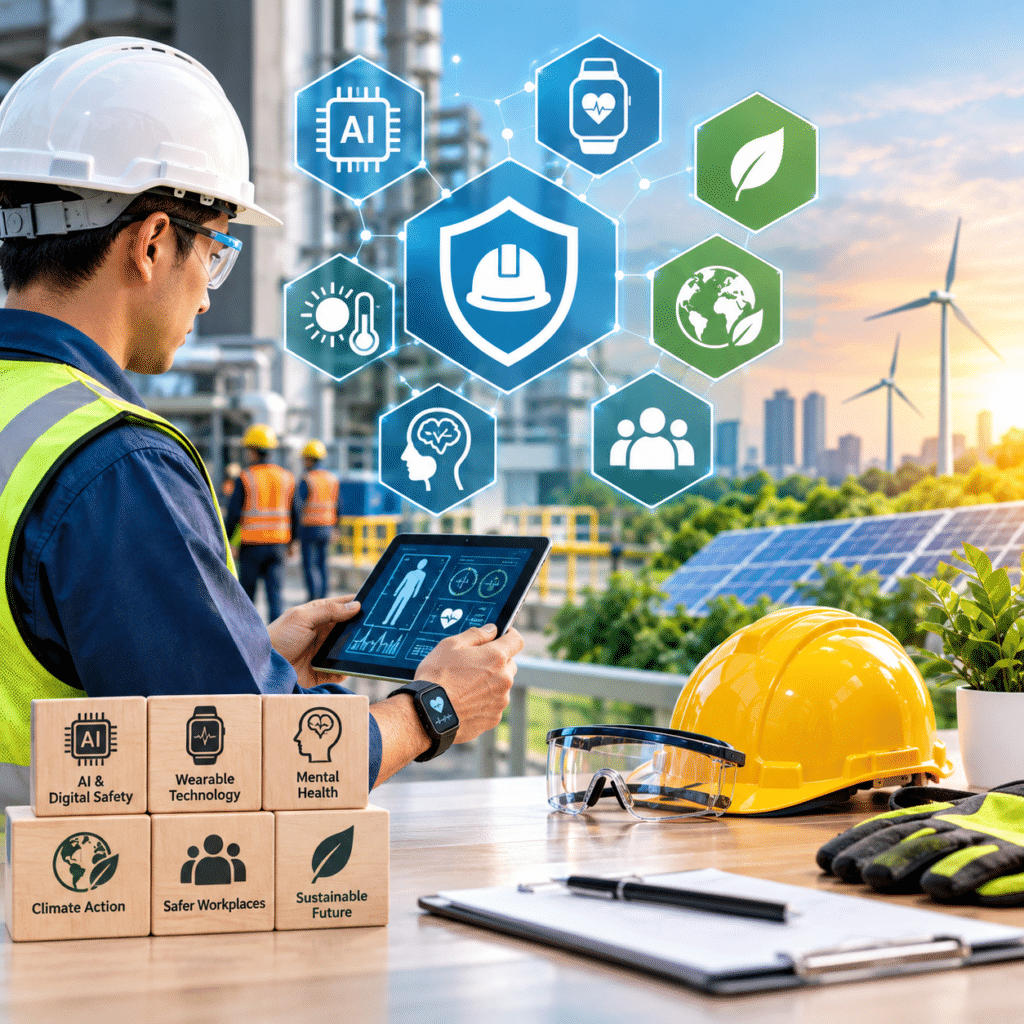
The Future of Health and Safety is changing rapidly as technology, climate change, new work arrangements, and growing awareness of employee well-being reshape workplaces. In 2027, organizations are expected to move beyond traditional safety programs and focus more on prevention, real-time monitoring, mental health, and data-driven risk management.
Recent International Labour Organization (ILO) research highlights artificial intelligence, digitization, psycho-social risks, occupational diseases, and climate-related hazards as important issues shaping the next generation of occupational safety and health.
1. Artificial Intelligence Will Transform Safety
Artificial intelligence is likely to become one of the most important technologies in the Future of Health and Safety. AI can analyze workplace information, identify patterns, monitor hazards, and support faster decision-making.
Automation and robotics can also perform dangerous or repetitive tasks, reducing workers’ exposure to hazardous machinery, toxic materials, extreme temperatures, and other risks. The ILO reports that AI, robotics, automation, and smart monitoring systems are already creating opportunities to improve occupational safety and health.
However, organizations must manage new risks such as excessive monitoring, privacy concerns, algorithmic decision-making, and over-reliance on automated systems.
2. Wearable Safety Technology Will Grow
Smart wearable devices are becoming increasingly useful for workplace protection. Wearable can potentially monitor environmental conditions, worker exposure, movement, fatigue indicators, or other safety-related signals.
Environmental sensors can also track conditions such as air quality and alert workers when risks increase. According to the ILO, smart wearable and environmental sensors are among the technologies changing occupational safety and health practices.
In 2027, these tools may become more common in construction, manufacturing, logistics, healthcare, agriculture, and other high-risk industries.
3. Mental Health Will Become a Safety Priority
The Future of Health and Safety will not focus only on physical injuries. Mental health and psycho-social risks are becoming increasingly important parts of workplace safety.
Work pressure, excessive workloads, poor work-life boundaries, lack of autonomy, workplace surveillance, and job insecurity can negatively affect worker well-being. The ILO’s 2026 research notes that AI-driven systems can introduce psycho-social risks through surveillance, work intensification, reduced autonomy, and concerns about data use.
Employers will therefore need stronger approaches to workload management, employee support, healthy work environments, and respectful workplace practices.
4. Climate Change and Heat Safety
Climate change is creating new health and safety challenges. Extreme heat can increase the risk of heat exhaustion, dehydration, and other heat-related illnesses, particularly for outdoor and physically demanding workers.
Heat protection is already becoming a major regulatory and workplace priority. In April 2026, the U.S. Occupational Safety and Health Administration updated its national emphasis program for indoor and outdoor heat hazards.
In 2027, organizations are likely to place greater emphasis on hydration, rest breaks, heat monitoring, emergency procedures, and work scheduling during extreme temperatures.
5. Prevention Will Replace Reaction
Traditional safety programs often focus on responding after accidents happen. Modern systems increasingly aim to identify hazards before an incident occurs.
Predictive analytic s, digital inspections, connected sensors, and better safety data can help organizations identify potential problems earlier. The ILO has emphasized proactive, evidence-informed, and participatory approaches when implementing digital safety technologies.
This shift toward prevention is likely to become a defining feature of the Future of Health and Safety.
6. Virtual Reality Will Improve Safety Training
Virtual reality (VR) and extended reality (XR) can provide workers with realistic training without exposing them to actual hazards.
For example, employees can practice emergency evacuation, equipment operation, fire response, or hazardous-environment procedures in a simulated setting. The ILO identifies virtual and extended reality as technologies that can transform workplace safety training, particularly in high-risk sectors.
By 2027, immersive training may become more accessible and practical for organizations seeking to improve worker preparedness.
7. Stronger Safety Policies and Worker Participation
Technology alone cannot create a safe workplace. Strong policies, effective inspections, employee training, and worker participation will remain essential.
The ILO stresses that workers should be involved in the adoption of new technologies, while governments, employers, safety professionals, and workers all have roles in ensuring digital transformation improves rather than compromises safety.
Organizations that combine technology with human judgment and clear safety procedures will be better positioned to manage emerging risks.
Challenges for 2027
Despite promising developments, the Future of Health and Safety will face several challenges. Technology can be expensive, smaller businesses may lack resources, and employees may require new digital skills.
There are also concerns about privacy, cybersecurity, inaccurate data, worker surveillance, and excessive dependence on automated systems. Organizations will need clear policies explaining how safety technology collects, stores, and uses information.
Conclusion
The Future of Health and Safety in 2027 will be shaped by artificial intelligence, wearable technology, predictive risk management, mental health awareness, climate adaptation, and immersive training. Current international developments already show a movement toward more proactive and technology-supported safety systems.
The most effective safety strategy will not be technology alone. It will combine innovation with strong policies, employee participation, professional training, human oversight, and a culture of prevention. As workplaces continue to evolve, organizations that make health and safety a long-term priority can create healthier, safer, and more resilient environments.